
What Is Inflammaging - And Why It Matters More After 40

You notice it in small ways first.
The morning stiffness that takes a little longer to shake off. The workout you used to recover from overnight that now needs two days. The afternoon slump that arrives earlier than it used to. Nothing dramatic. Nothing you would mention to anyone. Just a quiet sense that your body is running slightly differently than it did a decade ago.
Most people put this down to getting older and leave it there. But researchers studying human aging have spent the last twenty years identifying a specific biological process behind much of it and they gave it a name that has since become one of the most important concepts in longevity science.
They call it inflammaging.

Inflammaging: The Word Most People Have Never Heard
Inflammaging is a combination of two words: inflammation and aging. The term was introduced in 2000 by the Italian immunologist Claudio Franceschi, who was studying why some people reach their eighties and nineties in remarkable health while others decline much earlier.
What he described was this. As we get older, the body develops a persistent, low-grade level of inflammation that never fully switches off. It is not the sharp, obvious inflammation you get from a sprained ankle or a cut finger. It is quieter than that a background hum rather than an alarm. And because it produces no immediate symptoms, most people carry it for years without any awareness that it is there.
This is worth being precise about. Inflammaging is not a disease. It is not something you are diagnosed with. It is a normal biological process that happens to all of us as part of aging. What varies enormously between individuals is the degree to which it happens — and that degree is influenced by things largely within our control.
Why Inflammation Is Not the Enemy
To understand inflammaging, it helps to first understand what inflammation actually does.
Inflammation is one of the body's most valuable tools. When you cut yourself, immune cells rush to the site, blood flow increases, and the area becomes red and swollen. That is inflammation doing its job isolating the damage, clearing out debris, and beginning repair. Without it, we would not heal from anything.
The system is designed to work in short bursts. Activate, resolve, switch off.
The complication with aging is that the switching-off part becomes less efficient. Signals that should quiet down remain slightly elevated. Cellular debris that should be cleared accumulates instead. The immune system, which has spent decades responding to infections, injuries, and environmental exposures, becomes gradually less precise in how it calibrates its response.
The result is not dramatic. It is a small, permanent shift in the body's baseline and over years and decades, that small shift compounds.
What Actually Drives Inflammaging
Several overlapping factors contribute to inflammaging, and understanding them is what makes the concept genuinely useful rather than merely interesting.
Oxidative stress: Every day, your cells produce free radicals as a normal byproduct of turning food into energy. Free radicals are unstable molecules, and in reasonable quantities the body neutralises them without difficulty. But environmental factors — pollution, ultraviolet exposure, processed foods, chronic stress, poor sleep increase their production. When free radicals outpace the body's ability to neutralise them, the imbalance is called oxidative stress. And oxidative stress is one of the most significant contributors to the inflammatory signalling that defines inflammaging.
Cellular senescence: As cells age, some stop dividing but do not die. These are known as senescent cells, and they release inflammatory signalling molecules into surrounding tissue. A small number is normal. An accumulation over decades is a meaningful contributor to systemic inflammation.
Changes in the gut: The composition of gut bacteria shifts with age, and the intestinal barrier can become slightly more permeable. Both changes influence immune signalling throughout the body.
Accumulated exposure: Every infection fought, every injury repaired, every environmental toxin processed leaves a small residue of immune activation. Over sixty or seventy years, these add up.
Why the Forties Are a Turning Point
There is nothing magic about turning forty. The process described above is gradual and begins much earlier. But the forties are typically when the accumulated effect becomes noticeable enough that people start to feel it.
Recovery takes longer. Energy is less consistent through the day. Sleep quality changes. Joints feel different after activity. Skin loses some of its resilience.
This is also, importantly, the decade in which lifestyle choices start to produce visibly divergent outcomes. Two people of identical age can have measurably different inflammatory profiles depending on how they have eaten, slept, moved, and managed stress over the preceding twenty years and, crucially, how they choose to live going forward.
That last point is the one worth holding onto. Inflammaging is not fixed. It is not purely genetic. It responds to what we do.
The Role of Antioxidants
Given that oxidative stress is a primary driver of inflammaging, it follows that supporting the body's antioxidant capacity is one of the most direct ways to influence the process.
Antioxidants are compounds that neutralise free radicals, converting them into harmless molecules before they can damage cellular structures. The body produces some antioxidants internally. The rest we obtain from food.
This is the reason nutritionists have spent decades encouraging people to eat colourful plants. The pigments that give berries, vegetables, and certain grains their deep colours are frequently polyphenols a large family of plant compounds with significant antioxidant activity. Anthocyanins give blueberries their blue. Lycopene gives tomatoes their red. Betalains give beetroot its purple.
The general principle is straightforward: deeper natural colour often signals higher polyphenol content.
An Unusual Plant With an Unusual Compound
Which brings us to a plant most people outside West Africa have never encountered.
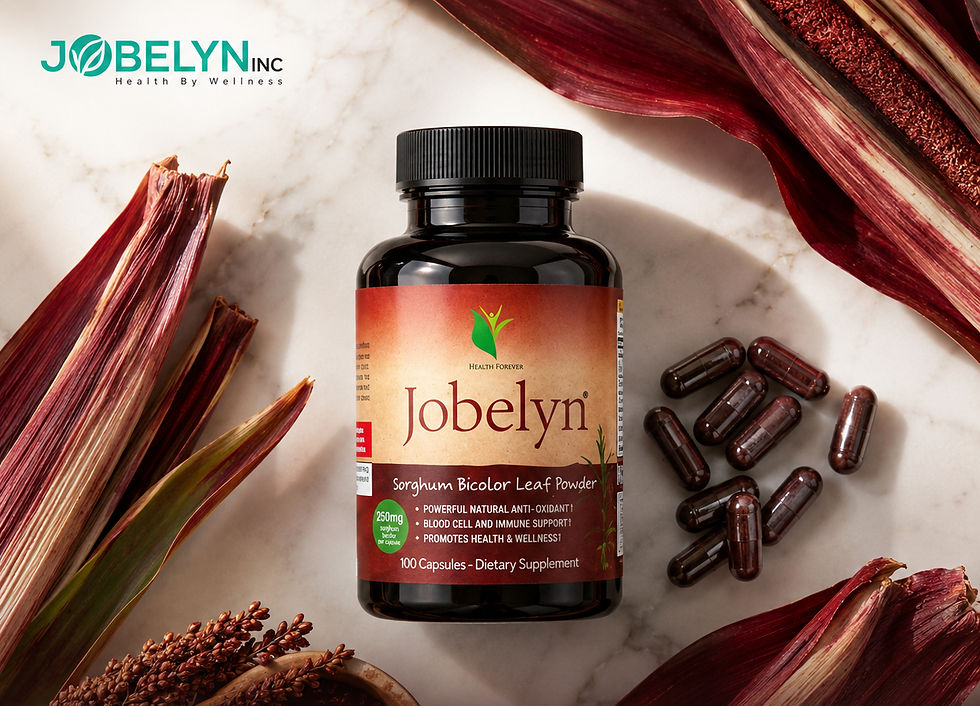
Sorghum bicolor is a cereal grain cultivated across the African continent for thousands of years. It is drought-resistant and hardy, which is why it became a staple crop in regions where other grains struggle. But the part that interests researchers is not the grain itself it is the leaf sheath, the outer casing of the plant, which is a striking deep crimson.
That colour comes from a rare class of compounds called 3-deoxyanthocyanidins, or 3-DXA. These are structurally distinct from the anthocyanins found in most coloured fruits, and they occur in significant concentration in very few plants on earth. Sorghum bicolor is the most notable source.
When measured using ORAC the Oxygen Radical Absorbance Capacity scale, a standard laboratory method for quantifying antioxidant strength Sorghum bicolor leaf sheath registers remarkably high. Its ORAC value is approximately three times that of acai berry, a fruit widely marketed for exactly this property.
Traditional healers across West Africa used the crimson leaf sheath in preparations passed down through generations, long before anyone had a laboratory method for measuring why it worked.
Where Jobelyn® Fits
Jobelyn® was developed to make this compound available in a consistent, convenient daily form. Each capsule contains one hundred per cent whole Sorghum bicolor leaf sheath powder organically grown, with no fillers, binders, or synthetic additives.
Alongside 3-DXA, the whole leaf sheath naturally contains polyphenols, phenolic acids, proanthocyanidins, selenium, omega-3 and omega-6 fatty acids, and vitamins A, B, and C.
Taken as two capsules daily, one in the morning and one in the evening. Jobelyn® supports cellular protection against oxidative stress, supports immune resilience, helps maintain healthy inflammatory balance, and supports overall vitality.
It is not a quick fix, and it is not presented as one. Antioxidant support works cumulatively. Most customers describe noticing changes in their daily energy within the first two to three weeks of consistent use, with more pronounced benefits over two to three months.
What You Can Actually Do
Supplementation is one input among several. If inflammaging is something you want to take seriously, these are the levers that matter most.
Prioritise sleep. Inadequate sleep measurably increases inflammatory signalling. Seven to eight hours is not indulgence, it is maintenance.
Move regularly. Moderate, consistent activity lowers inflammatory markers. Walking counts. Consistency matters more than intensity.
Eat colour. Deeply pigmented vegetables, berries, herbs, and spices deliver the polyphenols your antioxidant systems depend on.
Manage chronic stress. Sustained psychological stress keeps cortisol elevated, which influences immune regulation over time.
Support your antioxidant capacity. Through diet first, and through targeted supplementation where diet alone is insufficient.
None of these are dramatic interventions. That is rather the point. Inflammaging develops slowly through accumulated small factors, and it responds to accumulated small corrections.
The Way to Think About This
Aging is not a problem to be solved. It is a process to be navigated well.
What the research on inflammaging tells us is that the rate at which we experience the effects of aging is far more variable, and far more influenceable than most people assume. Two people the same age can occupy very different positions on that curve.
The choices are ordinary. Sleep. Movement. Food. Stress. Antioxidant support. Made consistently over years, they compound in exactly the same way the underlying process does.
Age is inevitable. How we age is not.
Ready to support your body's natural defences? Jobelyn® delivers 3-DXA™ from organically grown West African Sorghum bicolor with an ORAC antioxidant rating three times higher than acai berry.


Comments